Uberdiversified
Not Just Autism: The Deeper Architecture of H. divergens Minds
What Einstein, Leonardo, Aquinas, Jobs, Musk, Hopkins, and Edison teach us about neurodiversity beyond autism. Comparative overview table for seven public figures, followed by concise profiles for each, using a 0–4 numerical scale plus categorical labels for both Micro-16 (Divergens) and ASD adjacency. All ASD-related statements are non-diagnostic, probabilistic, and based only on public-domain descriptions.
- Scales and categories used
Micro-16 / Divergens Index (per marker and global)
- 0 = Very low / absent
- 1 = Low
- 2 = Moderate
- 3 = High
- 4 = Very high
Divergens Category (global)
- 0–1.4 ≈ Predominantly H. sapiens
- 1.5–2.4 ≈ Mixed / weakly Divergens
- 2.5–3.4 ≈ Hybrid
- 3.5–4.0 ≈ Predominantly H. divergens
ASD Adjacency (global heuristic, not diagnosis)
- 0–1 = Low ASD adjacency
- 2 = Moderate ASD adjacency
- 3–4 = High ASD adjacency
- High-level comparative table (global Divergens + ASD adjacency)
Table 1. Global Divergens and ASD-adjacency ratings (heuristic, historiometric)
| Figure | Global Divergens Index (0–4) | Divergens Category | ASD Adjacency Score (0–4) | ASD Adjacency Category | Confidence (re: profile) |
| Albert Einstein | 3.8 | Predominantly Divergens | 3 | High | High |
| Steve Jobs | 3.7 | Predominantly Divergens | 2 | Moderate | High |
| Thomas Aquinas | 3.5 | Predominantly Divergens | 2 | Moderate | Medium |
| Leonardo da Vinci | 3.9 | Predominantly Divergens | 1–2 (taken as 2) | Moderate (low–moderate) | Medium |
| Elon Musk | 4.0 | Predominantly Divergens | 4 | Very High | High |
| Anthony Hopkins | 3.2 | Hybrid (strong Divergens) | 3 | High | Medium |
| Thomas A. Edison | 3.6 | Predominantly Divergens | 2 | Moderate | Medium |
ASD adjacency reflects how many ASD-consistent behavioral and cognitive traits appear in biographies, interviews, and commentaries, not a clinical judgment.
- Marker set used (Micro-16, abbreviated labels)
For the individual profiles below, I treat the Micro-16 as 16 partially separable markers:
- M1 – High-level abstract / systemizing cognition
- M2 – Pattern detection & complexity appetite
- M3 – Monotropic attention & deep focus / flow
- M4 – Sensory atypicality
- M5 – Temporal focus & long-horizon planning
- M6 – Social signaling atypicality
- M7 – Social motivation & belonging style
- M8 – Emotional intensity & granularity
- M9 – Meta-cognition & self-observation
- M10 – Moral nonconformity & principle-driven reasoning
- M11 – Imagination, fantasy & world-building
- M12 – Creative productivity & innovation rate
- M13 – Risk, novelty & rule-breaking
- M14 – Attachment, pair-bonding & kinship style
- M15 – Spiritual / noetic orientation
- M16 – Erotic differentiation & atypical romantic/sexual scripts
- Concise comparative profiles
Each figure has:
- A Micro-16 marker table (0–4 + categorical)
- A small ASD-trait table
- A brief analytic summary (≈400–500 words)

4.1 Albert Einstein
Table 2. Micro-16 profile – Albert Einstein
| Marker | Score | Category |
| M1 Abstraction/systemizing | 4 | Very High |
| M2 Pattern detection/complexity | 4 | Very High |
| M3 Monotropic focus | 3 | High |
| M4 Sensory atypicality | 2 | Moderate |
| M5 Temporal / long-horizon | 3 | High |
| M6 Social signaling atypicality | 3 | High |
| M7 Social motivation/belonging | 2 | Moderate |
| M8 Emotional intensity/granularity | 2 | Moderate |
| M9 Meta-cognition/self-observation | 3 | High |
| M10 Moral nonconformity/principled | 3 | High |
| M11 Imagination/world-building | 3 | High |
| M12 Creative productivity/innovation | 4 | Very High |
| M13 Risk/novelty/rule-breaking | 3 | High |
| M14 Attachment/kinship style | 2 | Moderate |
| M15 Spiritual/noetic orientation | 3 | High |
| M16 Erotic differentiation | 2 | Moderate |
ASD-adjacent trait summary (Einstein)
| Domain | Rating (0–4) | Notes (very brief) |
| Social-communication | 3 | Odd social style, bluntness, limited small talk |
| Restricted interests/flow | 3 | Intense, lifelong focus on physics |
| Sensory / routines | 2 | Some rigidity, but not strongly documented |
Narrative summary
Einstein’s Micro-16 profile is dominated by extremely high abstraction and pattern cognition, extraordinary appetite for complex systems, and sustained monotropic engagement with theoretical physics. Biographies describe poor fit with conventional schooling, resistance to rote learning, and preference for self-directed, internally motivated problem-solving, suggesting high M1, M2, and M3. His creative productivity (M12) is clearly at the very high level, with a concentrated burst of breakthroughs and a long tail of influential work.
Socially, Einstein is often described as detached, somewhat aloof, and not especially concerned with conventional social signaling. Reports of bluntness, limited attention to dress and appearance, and an idiosyncratic relational style support high social-signaling atypicality (M6) and moderate alterations in social motivation (M7). Nonetheless, he maintained friendships, marriages, and professional networks, which argues against extreme social withdrawal.
On the ASD adjacency side, there is a well-known speculative literature arguing for “Einstein as autistic,” largely due to his language delay, intense special interests, and social eccentricities. This justifies a high but not maximal ASD adjacency (3/4) in this historiometric framework. However, the presence of flexible abstract thought, humor, and a capacity for political and moral engagement also supports the existence of Divergens traits that are not reducible to autism.
Global classification: Predominantly H. divergens, high ASD adjacency, with strong but not complete overlap between the two constructs.
4.2 Steve Jobs
Table 3. Micro-16 profile – Steve Jobs
| Marker | Score | Category |
| M1 Abstraction/systemizing | 3 | High |
| M2 Pattern detection/complexity | 3 | High |
| M3 Monotropic focus | 3 | High |
| M4 Sensory atypicality | 2 | Moderate |
| M5 Temporal / long-horizon | 3 | High |
| M6 Social signaling atypicality | 3 | High |
| M7 Social motivation/belonging | 3 | High |
| M8 Emotional intensity/granularity | 3 | High |
| M9 Meta-cognition/self-observation | 2 | Moderate |
| M10 Moral nonconformity/principled | 3 | High |
| M11 Imagination/world-building | 4 | Very High |
| M12 Creative productivity/innovation | 4 | Very High |
| M13 Risk/novelty/rule-breaking | 4 | Very High |
| M14 Attachment/kinship style | 2 | Moderate |
| M15 Spiritual/noetic orientation | 2 | Moderate |
| M16 Erotic differentiation | 2 | Moderate |
ASD-adjacent trait summary (Jobs)
| Domain | Rating (0–4) | Notes |
| Social-communication | 2 | Abrasive, blunt, but also highly charismatic |
| Restricted interests/flow | 2 | Deep focus on product and design |
| Sensory / routines | 2 | Food rituals, aesthetic sensitivity |
Narrative summary
Jobs displays a strongly Divergens profile with exceptional world-building imagination (M11) and high risk/novelty orientation (M13), coupled with sustained monotropic focus on design and user experience (M3). He integrated systems thinking (engineering + aesthetics + business) in a unified vision, indicating high abstraction and patterning, but always grounded in applied creativity rather than purely theoretical abstraction.
His social profile is complex: reports of extreme bluntness, volatile temper, and insensitivity to others’ feelings suggest social-signaling atypicality (M6). However, testimonies also emphasize powerful charisma, persuasive ability, and a talent for narrative framing in public presentations. This combination supports a Divergens pattern that overlaps partially but not strongly with ASD traits.
ASD adjacency is therefore rated moderate (2/4). There are some ASD-like elements (limited tolerance for small talk, intense focus, idiosyncratic routines), but prominent traits—charismatic stage performance, sophisticated framing of others’ emotions as part of product storytelling—also align with non-autistic profiles (and potentially other ND types such as ADHD or bipolar-spectrum traits, though that remains speculative).
Global classification: Predominantly H. divergens, moderate ASD adjacency, with Divergens traits expressed in a strongly social-influencing and entrepreneurial form rather than a primarily autistic one.
4.3 Thomas Aquinas
Table 4. Micro-16 profile – Thomas Aquinas
| Marker | Score | Category |
| M1 Abstraction/systemizing | 4 | Very High |
| M2 Pattern detection/complexity | 4 | Very High |
| M3 Monotropic focus | 3 | High |
| M4 Sensory atypicality | 1 | Low |
| M5 Temporal / long-horizon | 3 | High |
| M6 Social signaling atypicality | 2 | Moderate |
| M7 Social motivation/belonging | 2 | Moderate |
| M8 Emotional intensity/granularity | 2 | Moderate |
| M9 Meta-cognition/self-observation | 3 | High |
| M10 Moral nonconformity/principled | 3 | High |
| M11 Imagination/world-building | 3 | High |
| M12 Creative productivity/innovation | 4 | Very High |
| M13 Risk/novelty/rule-breaking | 2 | Moderate |
| M14 Attachment/kinship style | 1 | Low |
| M15 Spiritual/noetic orientation | 4 | Very High |
| M16 Erotic differentiation | 1 | Low |
ASD-adjacent trait summary (Aquinas)
| Domain | Rating (0–4) | Notes |
| Social-communication | 2 | Quiet, reserved, “dumb ox” nickname, later revered |
| Restricted interests/flow | 3 | Lifelong monastic focus on theology/philosophy |
| Sensory / routines | 1–2 | Monastic routine, but context-driven |
Narrative summary
Aquinas’ writings reveal extraordinary systemizing cognition (M1) and pattern integration (M2): the Summa projects an encompassing architecture integrating scripture, patristics, Aristotelian philosophy, and scholastic debate into a coherent theological–philosophical system. This is prototypical of a high Divergens cognitive profile: relentless abstraction, hierarchical conceptualization, and sustained monotropic focus (M3) on a tightly defined intellectual domain.
Theological output suggests high meta-cognition (M9) and spiritual/noetic orientation (M15), with detailed self-reflective and God-focused reasoning. Moral nonconformity (M10) appears more subtly, in his willingness to synthesize “pagan” Aristotle with Christian doctrine against some contemporary suspicion. Creative productivity (M12) is extremely high, even within a monastic setting.
ASD adjacency is moderate (2/4) and heavily speculative. His quiet demeanor and early underestimation by peers (the “dumb ox” story) might indicate atypical social signaling, although later reports show him functioning effectively in teaching, disputation, and ecclesial politics. Restricted interests and intense intellectual focus are strong, but may reflect scholastic culture rather than individual autism. There is limited evidence of sensory peculiarities or pronounced social-communication breakdowns.
Global classification: Predominantly H. divergens, heavily expressed in the noetic/theological domain, with moderate and uncertain ASD adjacency.
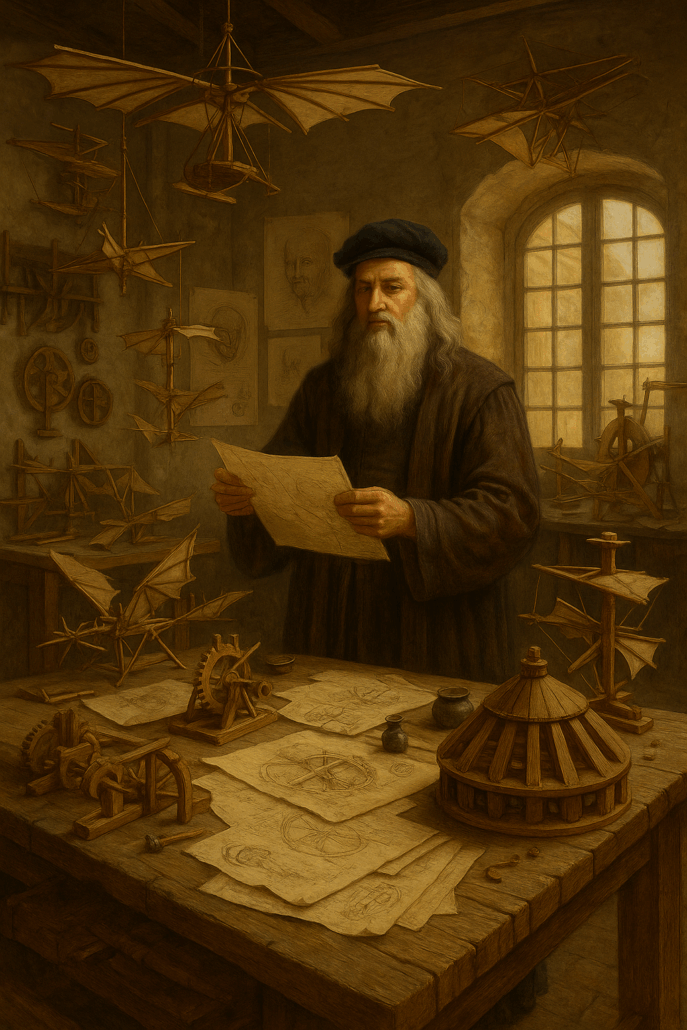
4.4 Leonardo da Vinci
Table 5. Micro-16 profile – Leonardo da Vinci
| Marker | Score | Category |
| M1 Abstraction/systemizing | 3 | High |
| M2 Pattern detection/complexity | 4 | Very High |
| M3 Monotropic focus | 3 | High |
| M4 Sensory atypicality | 2 | Moderate |
| M5 Temporal / long-horizon | 2 | Moderate |
| M6 Social signaling atypicality | 1–2 | Low–Mod |
| M7 Social motivation/belonging | 2 | Moderate |
| M8 Emotional intensity/granularity | 3 | High |
| M9 Meta-cognition/self-observation | 3 | High |
| M10 Moral nonconformity/principled | 3 | High |
| M11 Imagination/world-building | 4 | Very High |
| M12 Creative productivity/innovation | 4 | Very High |
| M13 Risk/novelty/rule-breaking | 3 | High |
| M14 Attachment/kinship style | 2 | Moderate |
| M15 Spiritual/noetic orientation | 2 | Moderate |
| M16 Erotic differentiation | 3 | High |
ASD-adjacent trait summary (Leonardo)
| Domain | Rating (0–4) | Notes |
| Social-communication | 1–2 | Generally sociable, patrons, workshops |
| Restricted interests/flow | 2 | Intense but wide-ranging, multi-domain |
| Sensory / routines | 1–2 | Artistic detail, but little clear rigidity |
Narrative summary
Leonardo exemplifies a multi-domain Divergens profile: extremely high pattern detection (M2) across anatomy, mechanics, hydrology, optics, and art; very high imagination and world-building (M11) in both technical diagrams and visual art; and very high creative productivity (M12) across heterogeneous fields. His notebooks show constant cross-domain transfer of ideas and a strong internal drive to understand underlying principles.
Socially, available biographies suggest he operated effectively within patronage networks, maintained workshops and apprentices, and functioned comfortably in elite courts. This contrasts with classic autistic social-communication difficulties and points toward lower ASD adjacency. His divergence appears in unconventional lifestyle, possible non-heteronormative erotic orientation (M16), and nonconformist moral–religious positioning, but without major social isolation.
ASD adjacency is therefore rated low–moderate (rounded to 2/4): there are ASD-consistent traits such as intense focus and niche expertise, but they coexist with broad social adaptability, playful communication, and ease of performance in social settings. Divergens here is expressed as polymathic, cross-modal creativity rather than a more circumscribed autistic cognitive style.
Global classification: Predominantly H. divergens, low-to-moderate ASD adjacency, Divergens ≫ autism in explanatory power.
4.5 Elon Musk
Table 6. Micro-16 profile – Elon Musk
| Marker | Score | Category |
| M1 Abstraction/systemizing | 4 | Very High |
| M2 Pattern detection/complexity | 4 | Very High |
| M3 Monotropic focus | 3 | High |
| M4 Sensory atypicality | 2 | Moderate |
| M5 Temporal / long-horizon | 4 | Very High |
| M6 Social signaling atypicality | 3 | High |
| M7 Social motivation/belonging | 2 | Moderate |
| M8 Emotional intensity/granularity | 3 | High |
| M9 Meta-cognition/self-observation | 2 | Moderate |
| M10 Moral nonconformity/principled | 3 | High |
| M11 Imagination/world-building | 4 | Very High |
| M12 Creative productivity/innovation | 4 | Very High |
| M13 Risk/novelty/rule-breaking | 4 | Very High |
| M14 Attachment/kinship style | 2 | Moderate |
| M15 Spiritual/noetic orientation | 2 | Moderate |
| M16 Erotic differentiation | 2 | Moderate |
ASD-adjacent trait summary (Musk)
| Domain | Rating (0–4) | Notes (public domain) |
| Social-communication | 3–4 | Explicit self-identification as autistic, flat/odd affect, online communication style |
| Restricted interests/flow | 3 | Intense focus on rockets, EVs, AI |
| Sensory / routines | 2–3 | Some rigidity and all-or-nothing work |
Narrative summary
Musk’s public self-identification as “having Asperger’s” (SNL appearance) strongly raises ASD adjacency within this framework, independent of any formal diagnostic details. His life history shows extreme systemizing cognition (M1), multi-layered pattern reasoning (M2) applied to engineering, industry structure, and long-horizon technological trajectories (M5), plus monotropic focus on a small number of mission-defined themes (space, energy, AI).
His social signaling (M6) is clearly atypical: unusual online communication, bluntness, apparent difficulty with conventional PR norms, and frequent misalignment with expected social cues. At the same time, he operates repeatedly in high-stakes team settings and investor-facing roles, which indicates some degree of social adaptability. Risk and novelty orientation (M13) are at the upper extreme, with repeated entry into high-failure-probability domains.
Given the public acknowledgment of autism and the convergence of multiple ASD-like traits, ASD adjacency is rated very high (4/4). Micro-16 scores show equally extreme Divergens traits, suggesting a case where autism and Divergens overlap strongly, although the Divergens framework also captures long-horizon civilizational aims and macro-level system-building that standard ASD constructs do not emphasize.
Global classification: Predominantly H. divergens, very high ASD adjacency, with substantial but not complete construct overlap.
4.6 Anthony Hopkins
Table 7. Micro-16 profile – Anthony Hopkins
| Marker | Score | Category |
| M1 Abstraction/systemizing | 2 | Moderate |
| M2 Pattern detection/complexity | 3 | High |
| M3 Monotropic focus | 3 | High |
| M4 Sensory atypicality | 2 | Moderate |
| M5 Temporal / long-horizon | 2 | Moderate |
| M6 Social signaling atypicality | 3 | High |
| M7 Social motivation/belonging | 2 | Moderate |
| M8 Emotional intensity/granularity | 3 | High |
| M9 Meta-cognition/self-observation | 3 | High |
| M10 Moral nonconformity/principled | 2 | Moderate |
| M11 Imagination/world-building | 3 | High |
| M12 Creative productivity/innovation | 3 | High |
| M13 Risk/novelty/rule-breaking | 2 | Moderate |
| M14 Attachment/kinship style | 2 | Moderate |
| M15 Spiritual/noetic orientation | 2 | Moderate |
| M16 Erotic differentiation | 1–2 | Low–Mod |
ASD-adjacent trait summary (Hopkins)
| Domain | Rating (0–4) | Notes (public statements, speculative) |
| Social-communication | 3 | Self-reported difficulties, social awkwardness |
| Restricted interests/flow | 2–3 | Intense focus on acting and preparation |
| Sensory / routines | 2 | Reported need for control/structure |
Narrative summary
Hopkins has openly discussed traits consistent with autism (e.g., possible Asperger’s), reporting social awkwardness, difficulty in ordinary social situations, and intense focus on his craft. This supports a high ASD adjacency (3/4) classification in this framework, while recognizing that details of clinical assessment are not public.
From a Micro-16 perspective, his Divergens profile is concentrated in pattern recognition and role-embodiment (M2), monotropic focus (M3) on acting and music, and rich emotional intensity (M8) harnessed into nuanced performance rather than unstructured expression. Meta-cognition (M9) is high, manifested in reflective commentary about his process, personality, and life history.
Social signaling atypicality (M6) appears in his self-report and others’ descriptions of him as introverted, blunt, or emotionally distant off-screen, while still being able to perform socially in controlled, scripted contexts. Compared to figures like Musk or Einstein, Hopkins’ Divergens index is slightly lower and more narrowly focused in the artistic domain, placing him in a Hybrid but strongly Divergens-leaning category.
Global classification: Hybrid with strong Divergens expression, high ASD adjacency, Divergens concentrated in artistic, performative, and introspective channels.
4.7 Thomas Alva Edison
Table 8. Micro-16 profile – Thomas Edison
| Marker | Score | Category |
| M1 Abstraction/systemizing | 3 | High |
| M2 Pattern detection/complexity | 3 | High |
| M3 Monotropic focus | 3 | High |
| M4 Sensory atypicality | 2–3 | Mod–High |
| M5 Temporal / long-horizon | 3 | High |
| M6 Social signaling atypicality | 2 | Moderate |
| M7 Social motivation/belonging | 2 | Moderate |
| M8 Emotional intensity/granularity | 2 | Moderate |
| M9 Meta-cognition/self-observation | 2 | Moderate |
| M10 Moral nonconformity/principled | 3 | High |
| M11 Imagination/world-building | 3 | High |
| M12 Creative productivity/innovation | 4 | Very High |
| M13 Risk/novelty/rule-breaking | 3 | High |
| M14 Attachment/kinship style | 2 | Moderate |
| M15 Spiritual/noetic orientation | 1 | Low |
| M16 Erotic differentiation | 1 | Low |
ASD-adjacent trait summary (Edison)
| Domain | Rating (0–4) | Notes |
| Social-communication | 2 | Abrupt, self-absorbed, but functional |
| Restricted interests/flow | 3 | Lab-centered, obsession with tinkering |
| Sensory / routines | 2–3 | Hearing loss; strong lab routines |
Narrative summary
Edison’s biographical record shows extreme creative productivity (M12), with hundreds of patents and a life organized around laboratory experimentation. His thinking style appears highly practical and iterative rather than purely abstract, but the degree of monotropic focus (M3) on technical invention is high. Risk and novelty orientation (M13) is significant in his repeated entrepreneurial ventures and willingness to push unproven technologies into the market.
Social reports describe him as self-absorbed, neglectful of conventional social life, and sometimes abrasive, but still able to collaborate with teams and engage with investors and partners. This suggests moderate social-signaling atypicality (M6) rather than a strongly autistic profile. Sensory differences are complicated by his significant hearing loss, which may alter social behavior without implying ASD-related sensory processing differences.
ASD adjacency is rated moderate (2/4): there are ASD-consistent traits in his narrow focus, repetitive experimentation, and social oddities, but also many features (pragmatic social networking, large-scale enterprise building, situational adaptability) that are not especially autistic in character. He fits well within a Divergens-inventor prototype, with autism as a possible but non-dominant explanatory factor.
Global classification: Predominantly H. divergens, moderate ASD adjacency, with Divergens largely expressed through relentless inventive labor and industrial system-building.